 Skip to content
Everything you need to know about cargo hold safety, IATA regulations, and how to protect your pet during international air travel to Europe.
If you’re planning an international move and your pet is coming with you, one question is probably keeping you up at night: is it actually safe to ship my pet by air?
It’s a completely valid concern. The idea of your dog or cat traveling in an airplane’s cargo hold can feel unsettling, especially when you’re already managing the stress of an overseas relocation. But here’s the truth that most pet owners are relieved to hear: airline pet transport has become remarkably safe, and the data backs that up.
At Pet Transport Pro, our owner has spent over 30 years moving thousands of pets internationally. Our team has firsthand knowledge of what happens behind the scenes at airports, inside cargo holds, and at arrival facilities across Europe. This guide will walk you through exactly how the process works, what safety measures are in place, and what you can do to make your pet’s flight as comfortable as possible.
Let’s address the biggest concern first. When people hear “cargo hold,” they often picture a dark, cold, noisy space. In reality, the section of the cargo hold designated for live animals on passenger aircraft is nothing like that.
The pet-designated area of the cargo hold is both pressurized and temperature-controlled, just like the passenger cabin above. The International Air Transport Association (IATA) sets strict temperature standards for transporting live animals, and airlines must maintain safe conditions throughout the entire flight.
This isn’t optional. Airlines that transport live animals must have the physical capability to maintain these conditions. If the cargo hold’s climate system malfunctions during pre-flight inspection, all pets must be rebooked on a different flight. There is no workaround.
It’s also important to understand the difference between what happens in the air versus on the ground. While the general public may face weather embargoes that prevent them from shipping pets during extreme heat or cold, professional agencies like Pet Transport Pro operate differently. We have access to specialty flights and manifest cargo with major carriers that aren’t available to individual shippers. We also use climate-controlled ground logistics to transport pets safely to and from the aircraft, allowing us to fly pets when the general public would be restricted by temperature cutoffs.
Not all sections of the cargo hold meet these standards, which is why only designated areas are used for animals. On modern passenger aircraft, the pet hold shares the same ventilation and pressurization system as the cabin, meaning your pet breathes the same quality of air as you do.
Aircraft noise is present in the cargo hold, but it’s not dramatically different from what passengers experience in the cabin. Most pets settle down shortly after takeoff. In our experience, the vast majority of dogs sleep through the cruising portion of their flight. The steady hum of the engines can actually have a calming effect once the initial takeoff vibration subsides.
After decades of managing pet transport operations, we can tell you that the flight itself is not where the greatest risks occur. The most critical moments happen on the ground.
The window between leaving the climate-controlled terminal and being loaded into the aircraft’s cargo hold is the period when pets are most exposed to outside temperatures. IATA regulations set strict limits on how long animals can be exposed to temperatures outside the safe range during these transfers, capping ground exposure at no more than 45 minutes. This is where our climate-controlled ground logistics give us a critical advantage, allowing us to manage this vulnerable window far more effectively than individual shippers can on their own.
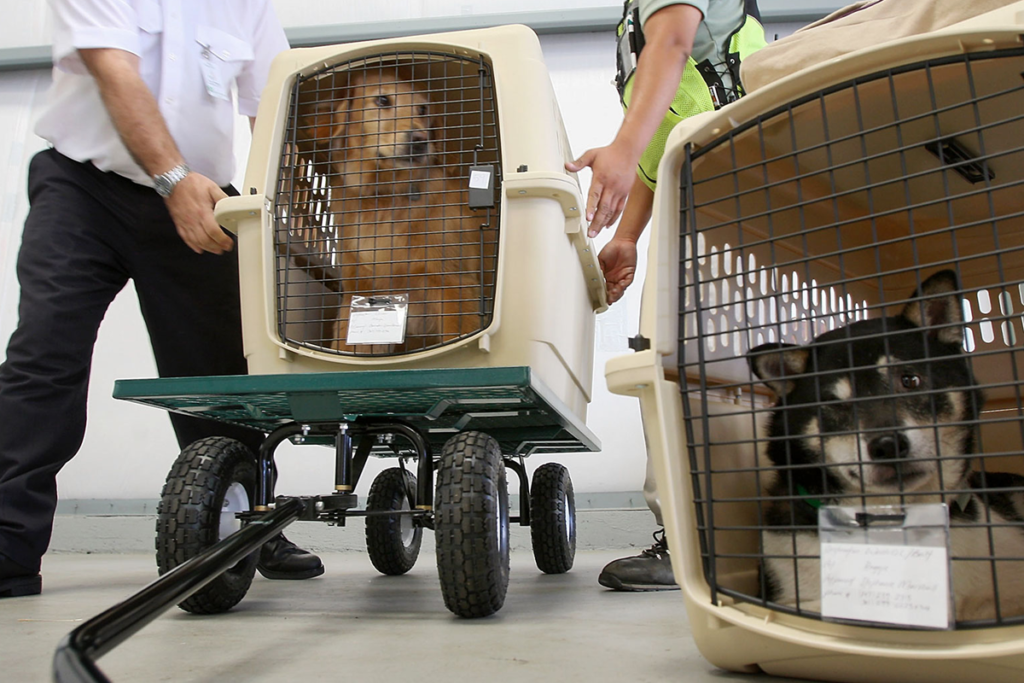
Responsible airlines and pet transport services to Europe take proactive steps to protect animals during these vulnerable ground moments:
Choosing the right airline makes a significant difference. Not all carriers follow the same protocols, and some go well above the minimum IATA standards. At Pet Transport Pro, we know which airlines provide the best care on every route, and we select carriers based on their specific animal handling procedures.
Understanding total crate time is important for planning your pet’s travel, especially for long-haul transatlantic flights. Here’s a realistic breakdown:
In total, pets on a direct transatlantic flight may be crated for approximately 12–18 hours. If the route involves a layover, that time can extend further.
When direct routes aren’t available, layovers become a factor. Some major hub airports operate dedicated animal care facilities where pets can be taken out of their crate, given food and water, and allowed to stretch during longer connections. London Heathrow’s animal facility is one well-known example.
However, not every airport offers this level of care, and not every routing option makes these facilities available. That’s one of the key reasons to work with an experienced pet relocation service. We specifically select routes and airlines that offer the best layover conditions when a direct flight isn’t possible.
Every pet is different. Larger dogs that have been properly crate-trained tend to handle long stretches well, often sleeping for much of the journey. Smaller breeds and cats may find it more challenging, and some crate soiling is normal on flights longer than 10 hours.
The single most effective thing you can do is acclimate your pet to their travel crate weeks before the trip. A pet that sees the crate as a safe, familiar space will experience far less stress than one encountering it for the first time at the airport.
Yes. IATA regulations and airline policies have clear rules about feeding and hydration during transport:
It’s worth knowing that many pets don’t eat during their flight. The unfamiliar environment can temporarily reduce appetite, and that’s a normal stress response rather than a medical concern. Hydration is less commonly affected. Most animals will drink at least some water during the journey.
Our team at Pet Transport Pro provides detailed pre-flight feeding guidance for every client. We’ll help you establish a schedule that keeps your pet comfortable without increasing the risk of motion discomfort during the flight.
The safety statistics around airline pet transport are genuinely reassuring. According to data compiled by airlines that transport live animals, the rate of pet fatalities during air cargo travel is less than 0.01%.
To put that in perspective: for every 10,000 pets that fly, fewer than one experiences a fatal incident. That makes airline pet transport one of the safest methods of long-distance pet relocation available.
Here’s something many pet owners don’t realize: reported incidents and health complications are actually higher with long-distance ground transport than with air travel. Ground moves involve extended periods under the care of transporters, longer overall transit times, more temperature fluctuation, and increased cumulative stress.
When moving a pet from the U.S. to Europe, air transport isn’t just the faster option. It’s typically the safer one, provided you’re working with the right airline and an experienced international pet shipping service.
In rare cases, health issues can appear in the hours or days following travel. Conditions like bloat or cardiac events can be influenced by travel stress, though pinpointing the exact cause is often difficult. Pre-existing conditions can also play a role.
This is why a thorough veterinary checkup before travel is so important. Your vet can identify any underlying conditions that might make air travel riskier for your specific pet, and our team can adjust the travel plan accordingly.
The International Air Transport Association (IATA) sets the global standard for transporting live animals by air through its Live Animals Regulations (LAR). Every airline that accepts pets must meet these minimum standards, and many exceed them.
Here are the two most important regulations pet owners should understand:
This regulation protects animals from extreme weather conditions at every stage of transport:
These temperature thresholds are the standard that triggers weather embargoes for the general public. However, as a professional pet transport agency, Pet Transport Pro has access to specialty flights and manifest cargo with major carriers that individual shippers cannot book. Combined with our climate-controlled ground logistics, we’re able to transport pets safely even when conditions would otherwise trigger an embargo for non-professional shippers.
These rules ensure pets stay nourished and hydrated:
These regulations reflect decades of refinement in animal welfare standards. Airlines that fail to comply face penalties, and most carriers have implemented their own additional safety protocols that go beyond the IATA minimums.
The pet transport industry looks very different today compared to even 10 years ago. Several important changes have made air travel significantly safer for animals:
These improvements mean that today’s pet owners can be more confident than ever about the safety of pet transport to Europe and other international destinations.
While airlines and regulators handle their part, there’s a great deal you can do as a pet owner to set your pet up for a safe, comfortable journey. Here’s a step-by-step preparation guide:
Give yourself enough runway. International pet transport to Europe requires specific veterinary steps that must happen within precise timeframes. Starting early ensures nothing gets rushed.
Most European countries require the following for dogs and cats entering from the U.S.:
Important note: An EU Pet Passport is not needed when traveling from the United States. The EU Pet Passport is a document issued within Europe for pets already residing in EU member states. For U.S.-origin pets, the USDA-endorsed international health certificate (APHIS 7001) is the required and accepted entry document for all European destinations.
Some countries have additional requirements. Germany, France, and Italy all follow general EU regulations, but entry procedures and airport inspections can vary. The United Kingdom and Switzerland have their own specific import rules that differ from standard EU protocols.
Your pet’s travel crate must be IATA-compliant and appropriately sized. Your pet should be able to stand, turn around, and lie down comfortably inside. The crate should have:
While most European countries follow the EU’s general pet import framework, individual nations have differences in how inspections are conducted, what documentation is checked at the point of entry, and whether additional steps apply. Here’s what to keep in mind for some of the most popular destinations:
Getting the details right for each country is where working with a professional Europe pet transport service makes all the difference. One missing document or a vaccination administered too late can delay or even prevent your pet’s entry.
You can technically manage your pet’s international air travel on your own. But there are compelling reasons why thousands of families choose to work with a professional pet transport service instead:
With our owner’s 30+ years of hands-on experience in the industry and USDA-licensed handlers on our team, Pet Transport Pro provides the kind of expert, personally managed service that gives families genuine peace of mind during what can otherwise be an overwhelming process.
Yes. Modern airline pet transport, when managed correctly, is safe, well-regulated, and thoroughly tested. The cargo hold is pressurized and temperature-controlled. IATA regulations set strict standards for feeding, watering, and temperature exposure. Pet fatality rates in air cargo are under 0.01%. And the industry continues to improve its protocols year after year.
The key factors that determine how safe and comfortable your pet’s experience will be are:
At Pet Transport Pro, we take every precaution to ensure your pet’s international flight is safe, well-planned, and as stress-free as possible. We handle everything from paperwork and USDA endorsements to airline booking, pickup, check-in, and arrival coordination across Europe.
Whether you're moving to London, Germany, Spain, or anywhere else in Europe, our team is here to guide you through every step. Contact Pet Transport Pro today for a free, no-obligation quote and see how simple international pet transport can be when you trust a pro.
Air travel for dogs from the U.S. to Europe is extremely safe when handled properly. Statistics show pet fatality rates in airline cargo are less than 0.01%. Airlines that accept live animals must follow IATA Live Animals Regulations, which include temperature-controlled cargo holds, mandatory feeding and watering schedules, and priority loading and unloading procedures. While the general public may face weather embargoes that prevent shipping during extreme temperatures, a professional agency like Pet Transport Pro has access to specialty flights and manifest cargo with major carriers, along with climate-controlled ground logistics, that allow us to fly pets safely when individual shippers would be restricted. Working with an experienced international pet transport company further reduces risk by ensuring the correct airline, route, crate, and documentation are selected for your dog’s specific needs.
To ship a dog to Germany from the U.S., your pet must have an ISO-compliant microchip, a current rabies vaccination administered at least 21 days before travel, an international health certificate (APHIS 7001) issued by a USDA-accredited veterinarian within 10 days of departure, and a USDA endorsement of that health certificate. Germany follows EU pet import regulations, so these documents must be in full compliance before your dog arrives. Pet Transport Pro handles the complete documentation and preparation process for families moving dogs to Germany.
For transatlantic flights from the U.S. to Europe, pets are typically crated from check-in (about 4–6 hours before departure) through arrival and customs clearance. Total crate time usually ranges from 12 to 18 hours depending on the route and whether layovers are involved. Choosing direct flights or airlines with pet-friendly layover facilities can reduce this time significantly. Pet Transport Pro selects routes and airlines specifically to minimize crate time and keep your pet as comfortable as possible.
The safest way to transport a pet overseas to Europe is to work with a professional pet relocation service that manages every detail. Key steps include starting preparations 30–60 days in advance, ensuring all vaccinations and health certificates are current, using an IATA-compliant travel crate your pet has been acclimated to, and booking a pet-friendly airline with temperature-controlled cargo holds. Pet Transport Pro provides full-service international pet transport with USDA-licensed handlers, led by an owner with over 30 years of hands-on experience moving pets to every major European destination.
Let’s discuss your test plan